Objectively assessing rosacea severity is difficult. A study demonstrates an AI approach for standardized, quantitative profiling that goes beyond the mere detection of redness.
Rosacea is a chronic inflammatory skin disease in which objective and reproducible assessment of disease severity remains challenging in both clinical practice and research. In this study we presented an AI-driven imaging approach for standardized, quantitative profiling of rosacea severity beyond visible redness alone.
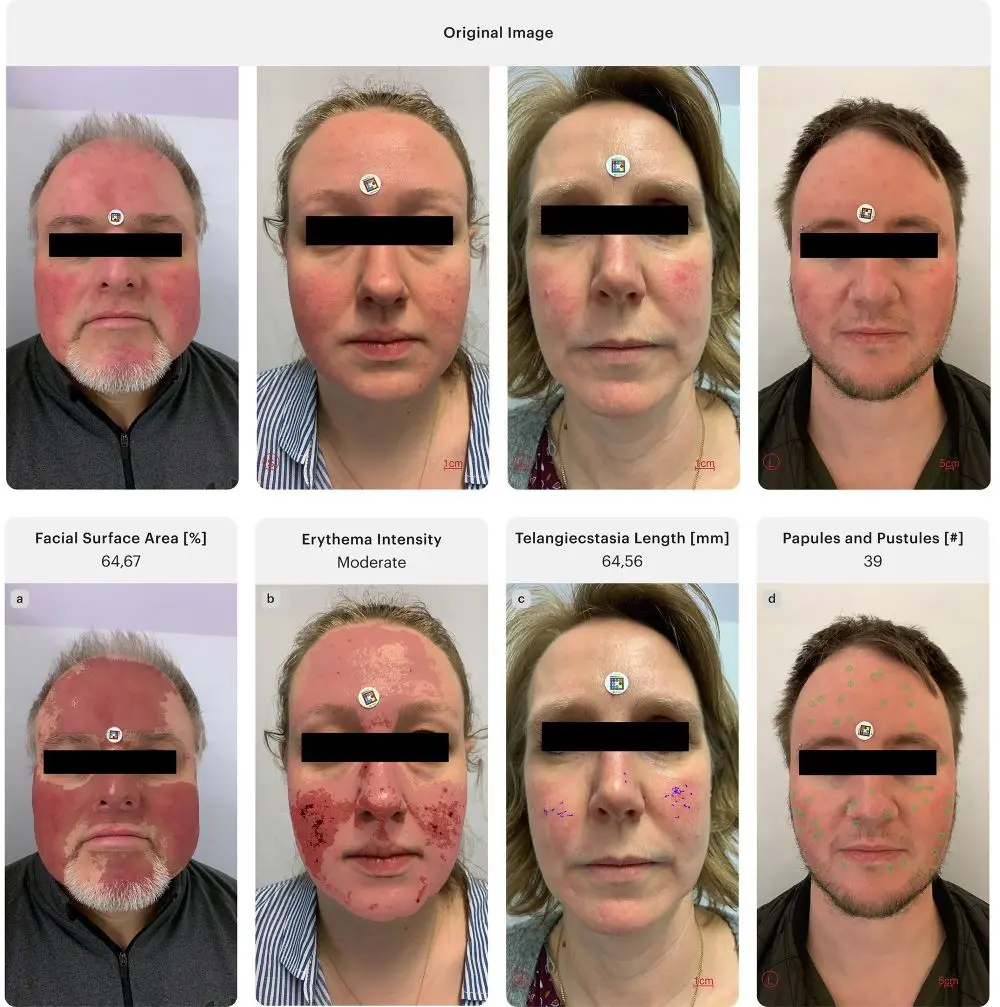
Using the clinically validated Scarletred® Vision Software Platform in combination with a mobile application and standardized image acquisition via a skin patch, facial images were collected longitudinally from 21 patients (355 images). The analysis is powered by Scarletred® ARORA AI-Agent, a multimodal artificial intelligence engine that coordinates image preprocessing, automated feature extraction, and longitudinal pattern analysis. The AI-Agent automatically quantified multiple rosacea-related morphological markers, including affected facial surface area, erythema intensity, telangiectasia length, and number of papules and pustules.
“With this work, our aim was to move beyond Subjective visual grading and provide dermatologists with an objective, standardized tool for assessing rosacea severity. Our AI-derived morphological biomarkers may support future digital endpoints in clinical trials and enable more personalized treatment strategies.”
Chiara Agostini, MSc., Data Scientist
The AI-based analysis accurately delineated erythematous regions, enabling objective measurement of erythema extension and intensity, while simultaneously detecting and quantifying telangiectatic structures, inflammatory lesions, and estimating the presence and severity of rhinophyma. Longitudinal analysis allowed visualization of erythema intensity dynamics and changes in morphological markers over time, supporting precise monitoring of disease progression and treatment response.
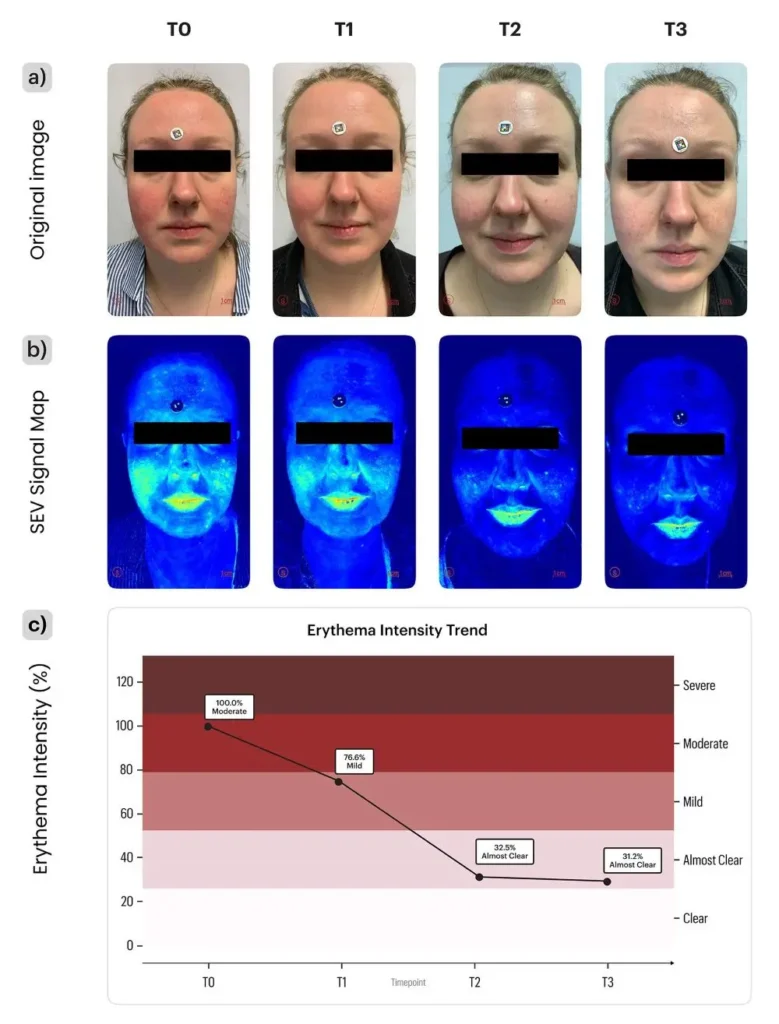
Our results demonstrate the potential of AI-enhanced facial imaging as a standardized, automated, and reproducible framework for rosacea assessment, paving the way toward more personalized and data-driven dermatological care. Our AI-supported framework enables objective, longitudinal rosacea assessment suitable for both routine clinical practice and decentralized monitoring. Unlike conventional ordinal grading systems, it provides continuous, quantitative metrics across multiple morphological dimensions, supporting reproducible digital clinimetry while minimizing inter- and intra-observer variability.
Authors: C. Agostini, M. Molnarova, M. Schaller, and H. Schnidar
Correspondence address:

Chiara Agostini, MSc
SCARLETRED Holding GmbH
Wien, Austria
Website: https://www.scarletred.com/
E-Mail: chiara.agostini@scarletred.com
Relevant links to current projects and research related to this work
Schaller, M., Riel, S., Bashur, R., Kurup, N., Schnidar, H., & Fehrenbacher, B. (2022). Ivermectin treatment in rosacea: How novel smartphone technology can support monitoring rosacea-associated signs and symptoms. Dermatologic Therapy, 35(11), Artikel e15869. https://doi.org/10.1111/dth.15869
Ranjan, R., Partl, R., Erhart, R., Kurup, N., & Schnidar, H. (2021). The mathematics of erythema: Development of machine learning models for artificial intelligence assisted measurement and severity scoring of radiation induced dermatitis. Computers in Biology and Medicine, 139, Artikel 104952. https://doi.org/10.1016/j.compbiomed.2021.104952
Partl, R., Jonko, B., Schnidar, S., Schöllhammer, M., Bauer, M., Singh, S., Simeckova, J., Wiesner, K., Neubauer, A., &
Schnidar, H. (2017). 128 SHADES OF RED: Objective remote assessment of radiation dermatitis by augmented digital skin imaging. Studies in Health Technology and Informatics, 236, 363–374: https://pubmed.ncbi.nlm.nih.gov/28508819/